Every healthcare practice faces the same communication challenge. Patients call at all hours. Your front desk has limited capacity. Important calls get missed during busy windows and after hours. The question is not whether you need professional call coverage. The question is which model of coverage actually delivers what your practice and your patients need.
The medical answering service vs in-house receptionist debate is one that practice administrators, clinic managers, and physician owners navigate regularly. Both options have real strengths and real limitations, and the right choice depends on your call volume, your patient demographics, and your operational priorities. Here is an honest, detailed comparison so you can make the decision with full information.
What a Medical Answering Service Actually Does
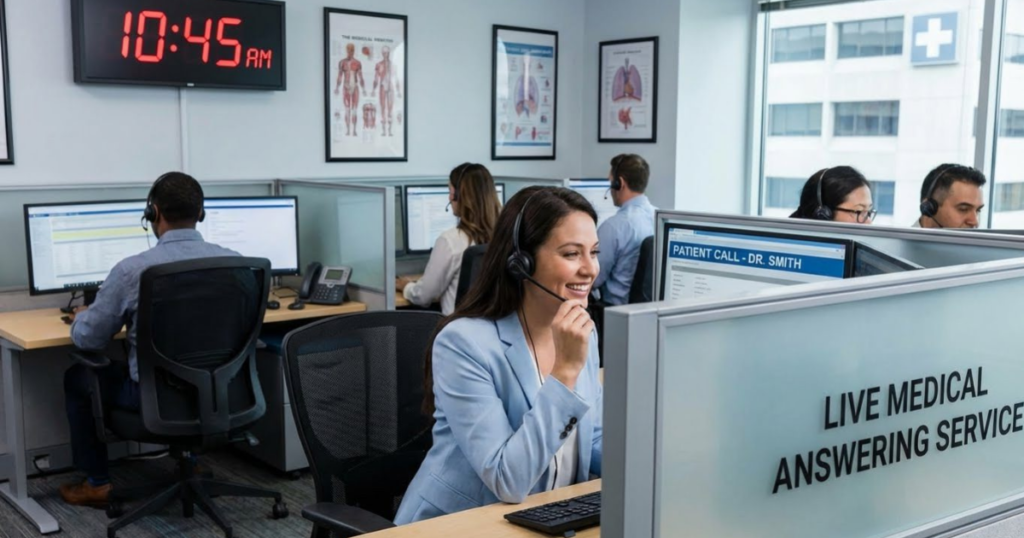
A medical answering service is a live operator team that handles your practice’s inbound calls when your in-house staff is unavailable. This typically includes after-hours calls, overflow during peak periods, lunch hour coverage, and holiday coverage. Operators follow a triage script, take messages, and route urgent calls directly to on-call providers per your established protocols.
Medical answering services do not, in most cases, have access to your electronic health records or scheduling system. They take a message and pass it to your team to action. Pricing is typically per-call or per-minute, generally ranging from .85 to .50 per minute, with monthly costs for small practices averaging to for after-hours and overflow coverage, according to Staffing for Doctors.
What an In-House Receptionist Provides
An in-house receptionist handles the full front-desk workflow during business hours. They answer calls, book appointments directly into your scheduling system, verify insurance, handle patient check-in, process co-pays, and manage the complete administrative layer of your in-person operations. They also have the contextual knowledge of your specific practice, your providers, and your patients that comes from working inside your office every day.
The cost of an in-house receptionist, when salary, payroll taxes, benefits, paid leave, and training are included, typically exceeds ,000 to ,000 per year in most markets. And that coverage stops when the business day ends, leaving after-hours callers with voicemail or no answer at all.
The Core Difference: EHR Access and Scope of Work
The most practical way to distinguish between a medical answering service and an in-house receptionist is whether the work requires access to your electronic health record system. A medical answering service cannot book an appointment directly into Athena, Epic, or eClinicalWorks. An in-house receptionist can.
According to Staffing for Doctors, a dedicated virtual medical receptionist, which is a more advanced model than a standard answering service, can work inside your EHR, manage scheduling, run waitlists, and handle the full front-desk workflow remotely. If your primary need is “take a message and route urgent calls,” a medical answering service is the right tool. If your need is “run the front desk,” an in-house or virtual receptionist is the right tool.
Coverage Models: Where Each Option Excels
Medical answering services are purpose-built for partial coverage situations: after hours, weekends, lunchtime overflow, and holiday periods. They are most valuable as the layer of coverage around an in-house front desk, catching calls that the in-house team cannot reach.
In-house receptionists excel during business hours in high-volume, complex environments where patient interactions require context, EHR access, and the ability to handle multistep administrative workflows in real time. They are essential for practices where in-person patient management is a significant part of daily operations.
The Case for Using Both
Many healthcare practices find that the medical answering service vs in-house receptionist comparison leads to the same conclusion: the optimal solution is not one or the other, but both working in coordination. The in-house receptionist manages business-hours call volume and EHR-dependent workflows. The medical answering service covers evenings, weekends, and holidays with professional triage and urgent call routing.
This combined model ensures that patients can reach a live person at any hour while keeping daytime operations fully supported by someone with deep practice knowledge. The handoff between the two, with overnight messages reviewed and returned by in-house staff the following morning, creates a consistent, professional patient communication rhythm.
HIPAA Is Non-Negotiable for Either Option
Any service handling patient calls is touching protected health information, which means HIPAA compliance is not optional. For in-house staff, HIPAA training is managed internally. For a medical answering service, you need to verify explicitly that operators are HIPAA-trained, that call handling follows PHI protection protocols, and that a business associate agreement is in place before any patient information is handled.
Do not assume compliance. Ask for documentation. A reputable medical answering service will have clear, well-documented answers to every HIPAA question you raise.
Making the Right Decision for Your Practice
The medical answering service vs in-house receptionist decision ultimately comes down to when your calls happen and what those calls require. For practices where patient communication is needed around the clock and after-hours responsiveness is critical, a medical answering service is an essential layer. For practices where complex EHR workflows and in-person administrative management are the priority, an in-house receptionist is indispensable.
For most practices, the answer is a thoughtful combination of both. Montana One Call provides HIPAA-aware medical answering services for healthcare providers across the Mountain West, offering 24/7 live operator coverage, professional triage protocols, and reliable after-hours patient communication. Give us a call to find the right coverage model for your healthcare practice today.